
Buying a home is exciting, but one question usually comes first: how much home loan can I get?
The answer isn’t based on your salary alone. Banks and housing finance companies usually look at your income, existing EMIs, age, credit history, employment, loan tenure and the value of the property you want to buy.
For example, a person earning ₹50,000 per month may qualify for a very different loan amount from someone with the same salary but several existing EMIs.
In this guide, you’ll learn how home loan eligibility works, how lenders estimate your borrowing capacity, and what you can do to improve your chances of getting a higher loan amount.
Important: The examples in this article are illustrations, not guaranteed loan offers. Every lender has its own eligibility policy, and the final amount depends on your complete application.
What Does Home Loan Eligibility Mean?
Home loan eligibility is the maximum loan amount a lender believes you can reasonably repay based on your financial profile.
It does not mean you should necessarily borrow the maximum amount offered.
A bank may approve a particular loan amount, but that doesn’t automatically mean the EMI will be comfortable for you.
Your personal budget should always come first.
If you’re new to home loans, start with our guide on what a home loan is and how it works.
Factors That Affect Home Loan Eligibility
Lenders generally consider several factors before deciding how much you can borrow.
| Factor | Why It Matters |
|---|---|
| Monthly income | Shows your repayment capacity |
| Existing EMIs | Reduces available income |
| CIBIL score | Shows your credit repayment history |
| Age | Affects available loan tenure |
| Employment | Indicates income stability |
| Loan tenure | Changes the monthly EMI |
| Property value | Limits the loan through LTV |
| Co-applicant income | May increase repayment capacity |
Let’s look at these factors one by one.
How Salary and Income Affect Home Loan Eligibility
Your income is one of the most important parts of the application.
A higher stable income generally gives you greater repayment capacity.
For salaried applicants, lenders may review:
- Monthly salary
- Salary slips
- Bank statements
- Form 16
- Employment history
- Existing financial obligations
For self-employed applicants, lenders may look at income tax returns, financial statements, business income and the stability of the business.
CIBIL also notes that lenders look at income, employment status, credit history and property-related factors when assessing a home loan application.
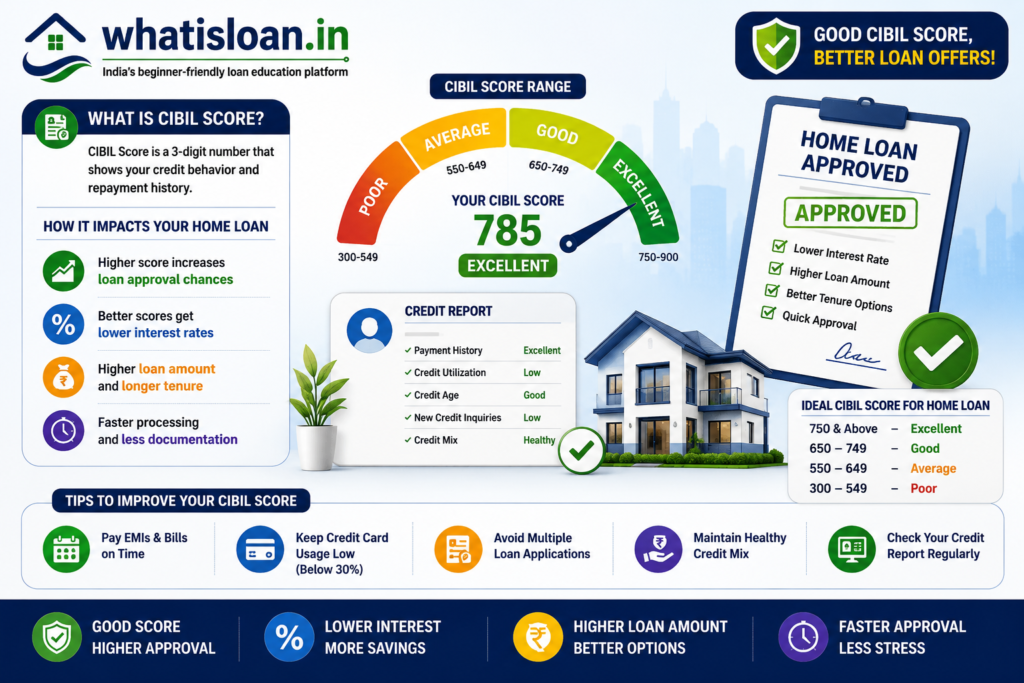
CIBIL Score and Home Loan Eligibility
Your CIBIL score gives lenders an idea of how you have handled credit in the past.
A strong score can improve your chances of approval and may help you negotiate better loan terms, although lenders use their own credit policies.
Before applying, check your credit report for:
- Missed payments
- Incorrect personal information
- Unpaid accounts
- Credit accounts you don’t recognize
- High outstanding balances
You can learn more in our detailed guide on what a CIBIL score is and how it works.
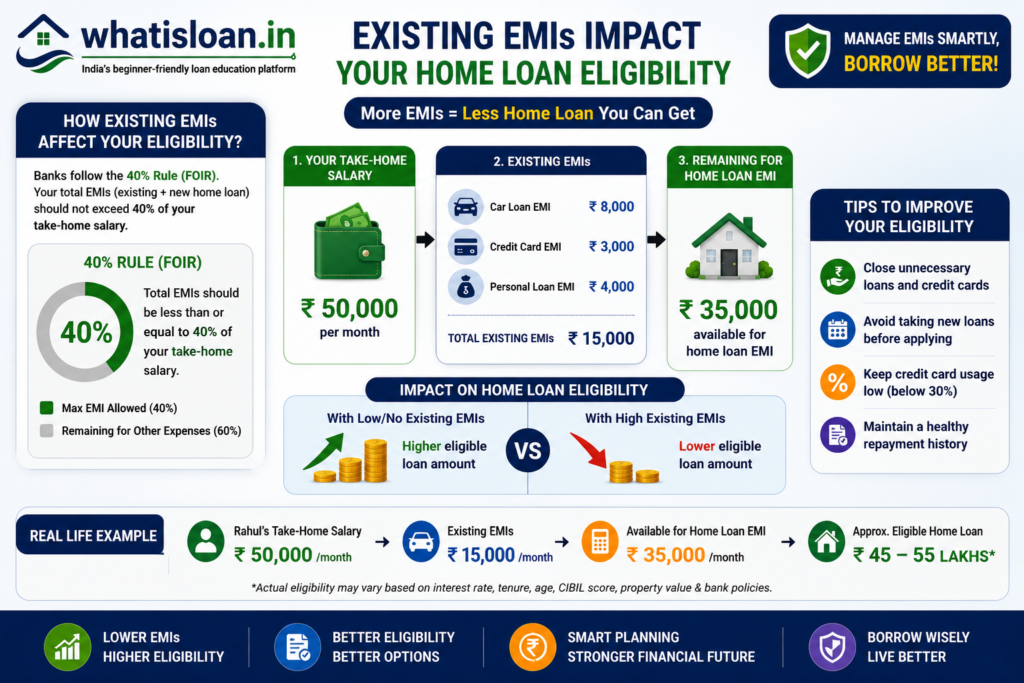
Existing EMIs and FOIR
Here’s an important point many first-time borrowers miss.
Banks don’t look only at your salary. They also look at how much of your income is already committed to debt.
This is where FOIR, or Fixed Obligation to Income Ratio, becomes useful.
In simple words, FOIR measures how much of your income is already going toward fixed financial obligations.
For example, suppose your monthly income is ₹60,000 and you already pay:
- Car EMI: ₹5,000
- Personal loan EMI: ₹5,000
You already have ₹10,000 of monthly commitments before adding the home loan.
Different lenders use different formulas and limits, so don’t treat 50% or 60% as a universal rule.
Age and Loan Tenure
Your age can have a major impact on eligibility.
A younger borrower may have access to a longer repayment period, while an older borrower may receive a shorter maximum tenure depending on the lender’s policy.
A longer tenure can reduce your monthly EMI, potentially increasing the loan amount you qualify for.
But there is a trade-off:
Longer tenure = lower EMI but potentially much higher total interest.
So don’t choose a 30-year loan simply because it increases your eligibility.
Property Value and LTV
The value of the property also limits how much you can borrow.
This is known as the Loan-to-Value (LTV) ratio.
For scheduled commercial banks, RBI’s framework has prescribed LTV ceilings for individual housing loans. The RBI’s current handbook shows ceilings of up to 90% for certain smaller housing loans, 80% for loans above ₹30 lakh up to ₹75 lakh, and 75% above ₹75 lakh for the relevant category.
This means you generally need to contribute some money yourself.
For example, if a property costs ₹50 lakh and the applicable financing limit is 80%, the maximum loan based on that LTV would be ₹40 lakh.
You would need to arrange the remaining amount yourself, along with applicable transaction costs.
Salaried vs Self-Employed Applicants
Eligibility requirements vary between lenders, but the assessment often looks different for salaried and self-employed borrowers.
| Factor | Salaried | Self-Employed |
|---|---|---|
| Main income proof | Salary slips, Form 16 | ITRs and financial records |
| Income assessment | Salary and employment | Business/professional income |
| Employment history | Job stability | Business continuity |
| Bank statements | Usually reviewed | Usually reviewed |
| Credit history | Important | Important |
Always check the specific lender’s document and eligibility requirements before applying.
How Banks Calculate Home Loan Eligibility
A simplified way to understand the calculation is:
Step 1: Start with your monthly income.
Step 2: Account for existing EMIs and fixed obligations.
Step 3: Estimate how much EMI you can comfortably afford.
Step 4: Consider the interest rate and loan tenure.
Step 5: Check whether the property value supports the required loan under applicable LTV limits.
For example:
Monthly income = ₹60,000
Suppose a lender’s assessment allows an illustrative total EMI capacity of ₹30,000.
If you already pay a ₹5,000 car EMI:
₹30,000 − ₹5,000 = ₹25,000
So around ₹25,000 remains for the home loan EMI in this simplified example.
The actual lender calculation can be different.
How Much Home Loan Can I Get on Different Salaries?
The following examples are illustrative only.
Assume:
- No existing EMIs
- 20-year tenure
- Interest rate of 8.5%
- Illustrative EMI capacity of 50% of monthly income
| Monthly Income | Illustrative EMI Capacity | Approx. Loan Amount* |
|---|---|---|
| ₹30,000 | ₹15,000 | ₹17–18 lakh |
| ₹50,000 | ₹25,000 | ₹28–29 lakh |
| ₹1,00,000 | ₹50,000 | ₹57–58 lakh |
*These are rough mathematical illustrations, not lender quotations. Actual eligibility may be lower or higher depending on your age, credit profile, existing obligations, lender policy, interest rate and property value.
This is why you should use a lender’s home loan eligibility calculator before making a property purchase decision.
How to Increase Your Home Loan Eligibility
If the amount you’re eligible for isn’t enough, don’t immediately apply to multiple lenders.
First improve your financial profile.
1. Add an Eligible Co-Applicant
A working spouse or other eligible family member may increase combined repayment capacity.
The lender will still assess the co-applicant’s income, credit history and other obligations.
2. Reduce Existing Debt
Paying off smaller loans or reducing outstanding obligations can free up monthly income for the proposed home loan.
3. Improve Your CIBIL Profile
Pay EMIs and credit card bills on time and avoid taking unnecessary new credit before applying.
4. Consider a Longer Tenure Carefully
A longer tenure can reduce the EMI and may improve eligibility, but you’ll potentially pay more interest over time.
5. Increase Your Down Payment
A larger down payment reduces the amount you need to borrow and can make the overall loan more manageable.
6. Declare Genuine Additional Income
If you have documented rental, professional or other eligible income, make sure it is properly reported. Don’t exaggerate income simply to qualify for a bigger loan.
Common Mistakes That Can Reduce Your Eligibility
Avoid these mistakes before applying:
- Applying with a poor credit history
- Taking new loans shortly before applying
- Having too many existing EMIs
- Ignoring credit report errors
- Choosing a property with legal or title issues
- Assuming bank approval equals affordability
- Applying for a larger loan than you actually need
Our guide on home loan mistakes to avoid before applying covers these problems in greater detail.
You can also use our 3/20/30/40 rule for home loans as a budgeting framework before deciding how much house you can afford.
Key Takeaways
- Home loan eligibility depends on more than salary.
- Income, CIBIL score, existing EMIs, age, tenure and property value all matter.
- FOIR helps lenders assess your existing financial obligations.
- LTV limits how much of the property’s value can be financed.
- A co-applicant may increase combined eligibility.
- A longer tenure can increase borrowing capacity but may increase total interest.
- Getting the maximum loan approved does not mean you should borrow the maximum amount.
Conclusion
So, how much home loan can you get? There isn’t one universal formula that works for every borrower.
Your income gives the lender a starting point, but your existing EMIs, CIBIL score, age, employment stability, chosen tenure and property value all influence the final number.
The smartest approach is to first calculate what EMI you can comfortably afford, then see how much loan that EMI supports. Don’t start with the maximum amount a bank is willing to offer.
Before applying, compare lenders using our guide to the best banks for home loans in India, check your home loan documents checklist, and understand the total cost of borrowing.
A home loan should help you buy a home without making the rest of your financial life difficult.
Frequently Asked Questions
How much home loan can I get on a ₹50,000 salary?
There is no fixed amount. As an illustration, a borrower with ₹50,000 monthly income and no existing EMI might qualify for around ₹28–29 lakh under the assumptions used above. Actual lender eligibility can differ substantially.
How much home loan can I get on ₹1 lakh salary?
Using the same illustrative assumptions, the amount could be around ₹57–58 lakh. However, the lender’s actual calculation will depend on your complete profile and the property.
Can I get a home loan equal to 100% of the property value?
Generally, you should not assume that a lender will finance 100% of the property’s value. Applicable LTV limits require the borrower to contribute part of the purchase cost.
Does a higher CIBIL score guarantee home loan approval?
No. A strong credit score helps, but lenders also consider income, employment, existing debt, property details and other factors.
Does pre-approved home loan mean final approval is guaranteed?
No. A pre-approved or in-principle amount is not necessarily the same as final sanction. The lender may still verify your documents, property and other details.
Can a co-applicant increase my home loan eligibility?
Yes, an eligible co-applicant with additional income may improve combined repayment capacity. The lender will assess both applicants.
**Disclaimer:** The information provided on WhatIsLoan.in is for educational and informational purposes only. We do not provide financial, legal, tax, investment, or loan approval services. Loan eligibility, interest rates, terms, and policies may vary by lender and can change over time. Readers should verify information with banks, NBFCs, government authorities, or qualified financial advisors before making any financial decisions. WhatIsLoan.in is not responsible for any losses or decisions made based on the information published on this website.