
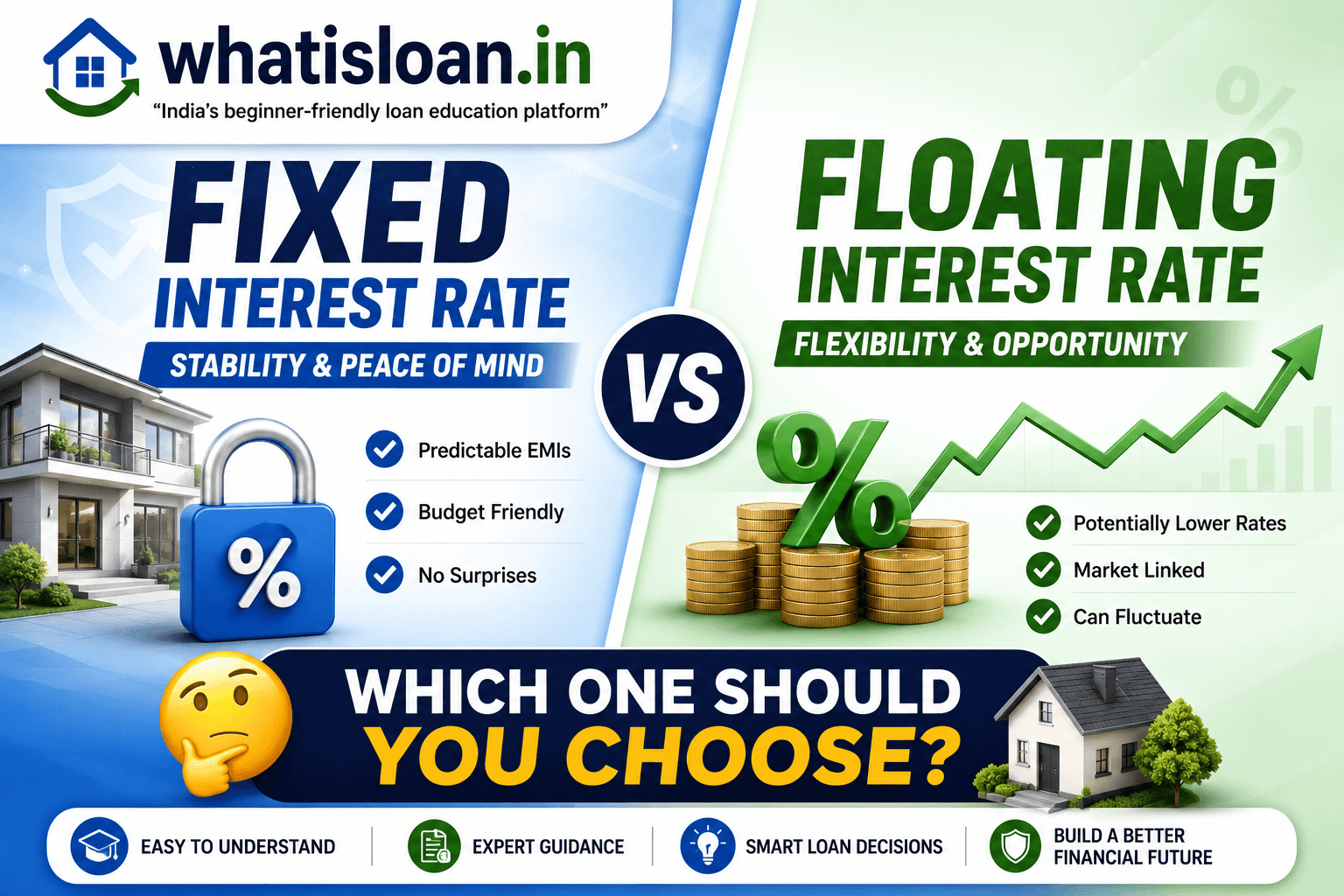
When you take a loan, the lender charges interest on the borrowed amount. This interest is the extra money you pay for using the lender’s money. But before choosing any loan, one important question comes up:
Should you choose a fixed interest rate or a floating interest rate?
Both options have their own benefits and risks. A fixed rate gives stable payments, while a floating rate can change over time. The right choice depends on your income, loan amount, loan tenure, risk comfort, and future interest rate movement.
Let’s understand both in simple language.
What Is a Fixed Interest Rate?
A fixed interest rate means the interest rate remains the same for a specific period or sometimes for the full loan tenure.
For example, if you take a loan at 10% fixed interest, your interest rate will not change during the fixed-rate period. Your EMI will usually remain the same every month.
This makes fixed interest rates easier to understand and easier to plan for.
Simple Example of Fixed Interest Rate
Suppose you borrow ₹5,00,000 at a fixed interest rate of 10% for 5 years.
If your monthly EMI is ₹10,624, it will generally stay the same throughout the fixed-rate period.
Even if market interest rates increase later, your EMI will not increase during that fixed period.
This is why many people who want stable monthly payments prefer fixed interest rates.
Benefits of Fixed Interest Rate
A fixed interest rate is useful when you want certainty and peace of mind.
1. EMI Remains Stable
The biggest benefit of a fixed rate is that your EMI usually stays the same. You know exactly how much money you need to pay every month.
This helps you plan your monthly budget easily.
2. Protection From Rising Interest Rates
If market interest rates increase, your fixed-rate loan is protected during the fixed period. Your EMI does not suddenly go up.
This can be helpful when interest rates are expected to rise.
3. Easy for First-Time Borrowers
Fixed rates are simple to understand. There are fewer surprises, which makes them suitable for first-time loan borrowers.
4. Better for People With Fixed Income
If your salary or income is fixed every month, a fixed EMI can make repayment more comfortable.
You can manage rent, school fees, household expenses, savings, and EMI without worrying about sudden changes.
Disadvantages of Fixed Interest Rate
A fixed interest rate also has some drawbacks.
1. Usually Higher Than Floating Rate
Fixed interest rates are often slightly higher than floating rates. Lenders charge more because they are giving you rate stability.
So, your starting EMI may be higher.
2. No Benefit When Rates Fall
If market interest rates decrease, you may not get the benefit immediately. Your loan may continue at the same fixed rate.
This means you could end up paying more than someone who chose a floating rate.
3. May Have Extra Charges
Some lenders may charge fees if you want to switch from fixed to floating rate or close the loan early.
Always check the terms before choosing a fixed-rate loan.
What Is a Floating Interest Rate?
A floating interest rate means the interest rate can change during the loan period.
It moves up or down based on market conditions, lender policies, benchmark rates, and financial regulations.
If interest rates decrease, your EMI or loan tenure may reduce. If interest rates increase, your EMI or loan tenure may go up.
Simple Example of Floating Interest Rate
Suppose you borrow ₹5,00,000 at a floating interest rate of 9.5%.
After some time, the lender increases the rate to 10.5%. In this case, your EMI may increase, or your loan tenure may become longer.
But if the rate falls to 9%, your EMI may reduce, or your loan may finish earlier.
This is why floating interest rates are flexible but less predictable.
Benefits of Floating Interest Rate
Floating rates can be useful for borrowers who are comfortable with some changes.
1. Usually Lower Starting Rate
Floating interest rates are often lower than fixed rates at the beginning. This can make the initial EMI more affordable.
2. Benefit When Interest Rates Fall
If market rates go down, floating-rate borrowers may benefit. Their EMI may reduce, or their loan tenure may become shorter.
This can help save money on total interest.
3. Useful for Long-Term Borrowers
For longer loan tenures, interest rates may rise and fall many times. Floating rates allow borrowers to benefit during falling rate periods.
4. More Flexible in Many Cases
Floating-rate loans may come with more flexible repayment options, depending on the lender and loan type.
Disadvantages of Floating Interest Rate
Floating interest rates also come with risk.
1. EMI Can Increase
If interest rates rise, your EMI may increase. This can affect your monthly budget.
2. Loan Tenure Can Become Longer
Sometimes lenders do not increase EMI immediately. Instead, they increase the loan tenure.
This means you may pay the loan for a longer time and pay more total interest.
3. Less Predictable
Floating rates are harder to plan because they can change. This may not be comfortable for people who want fixed monthly payments.
4. Can Be Stressful During Rate Hikes
When rates rise again and again, borrowers may feel financial pressure. This is especially true if income does not increase at the same speed.
Fixed vs Floating Interest Rate: Key Difference
Here is a simple comparison:
| Point | Fixed Interest Rate | Floating Interest Rate |
|---|---|---|
| Rate movement | Usually remains same during fixed period | Changes based on market rates |
| EMI | Mostly stable | Can increase or decrease |
| Budget planning | Easier | Less predictable |
| Starting rate | Usually higher | Usually lower |
| Risk level | Lower | Higher |
| Benefit when rates fall | Usually no immediate benefit | Can get benefit |
| Best for | Stability-focused borrowers | Flexible borrowers |
Which One Should You Choose?
There is no single best option for everyone. The right choice depends on your financial situation.
Choose Fixed Interest Rate If:
You may choose a fixed interest rate if:
- You want stable EMI
- You have a fixed monthly income
- You do not want payment surprises
- You are worried that interest rates may increase
- You are a first-time borrower
- You prefer simple and predictable repayment
A fixed rate is better for people who value peace of mind more than possible savings.
Choose Floating Interest Rate If:
You may choose a floating interest rate if:
- You can handle EMI changes
- You want a lower starting interest rate
- You believe interest rates may fall
- You have extra income or savings to manage rate changes
- You are comfortable with some financial risk
- You want to benefit from market rate reductions
A floating rate is better for people who are flexible and can manage changes in EMI or tenure.
How a Calculator Can Help You Decide
Before choosing fixed or floating interest rate, you should use an EMI calculator or interest rate comparison calculator.
A calculator can show you:
- Monthly EMI
- Total interest payable
- Total repayment amount
- Difference between two interest rates
- How much you may save with a lower rate
For example, even a 1% difference in interest rate can create a big difference in total repayment, especially on large loans or long tenures.
This helps you compare both options clearly before applying for a loan.
Important Things to Check Before Choosing
Before selecting fixed or floating interest rate, check these points carefully:
- Processing fees
- Prepayment charges
- Foreclosure charges
- Switching charges
- Loan tenure
- Interest reset period
- Benchmark rate used by the lender
- Whether EMI will change or tenure will change
- Total interest cost
- Your monthly income stability
Do not choose a loan only because the EMI looks low. Always check the total repayment amount.
Common Mistakes to Avoid
Many borrowers make mistakes while choosing interest rate type. Try to avoid these:
1. Looking Only at EMI
A lower EMI does not always mean a cheaper loan. Sometimes a longer tenure reduces EMI but increases total interest.
2. Ignoring Total Interest Cost
Always check how much total interest you will pay over the full loan period.
3. Not Comparing Lenders
Different lenders may offer different rates and charges. Compare at least a few options before applying.
4. Not Reading Loan Terms
Check whether the rate is fixed for the full tenure or only for a few years. Also check how floating rate changes are applied.
5. Choosing Without Using a Calculator
A calculator gives clear numbers. Without calculation, it is easy to choose the wrong option.
Fixed or Floating: Quick Decision Guide
If you want safety, choose fixed.
If you want flexibility, choose floating.
If your income is stable but limited, fixed may be better.
If your income is growing and you can handle changes, floating may be better.
If interest rates are expected to rise, fixed may be useful.
If interest rates are expected to fall, floating may be useful.
FAQs
Which is better, fixed or floating interest rate?
Fixed interest rate is better if you want stable EMI and predictable payments. Floating interest rate is better if you can handle EMI changes and want to benefit when market rates fall.
Is floating interest rate risky?
Yes, floating interest rate has some risk because your EMI or loan tenure can increase when interest rates rise.
Why is fixed interest rate usually higher?
Fixed interest rate is usually higher because the lender gives you stability and takes the risk of future rate changes.
Can I switch from fixed to floating interest rate?
Many lenders allow switching, but they may charge a fee. You should check the lender’s terms before making a decision.
Does floating interest rate always save money?
No. Floating interest rate can save money when rates fall, but it can become costly when rates rise.
Final Words
Fixed and floating interest rates both have advantages and disadvantages.
A fixed interest rate gives stability, easy budget planning, and protection from rising rates. A floating interest rate gives flexibility and the chance to save money when rates go down.
Before choosing, compare EMI, total interest, repayment amount, fees, and your own income situation. Use a calculator to check the real cost difference.
The best interest rate is not always the lowest one. The best option is the one that fits your budget, risk comfort, and repayment plan.
**Disclaimer:** The information provided on WhatIsLoan.in is for educational and informational purposes only. We do not provide financial, legal, tax, investment, or loan approval services. Loan eligibility, interest rates, terms, and policies may vary by lender and can change over time. Readers should verify information with banks, NBFCs, government authorities, or qualified financial advisors before making any financial decisions. WhatIsLoan.in is not responsible for any losses or decisions made based on the information published on this website.




1 thought on “Fixed vs Floating Interest Rate: Which One Should You Choose?”